RXB Workstation
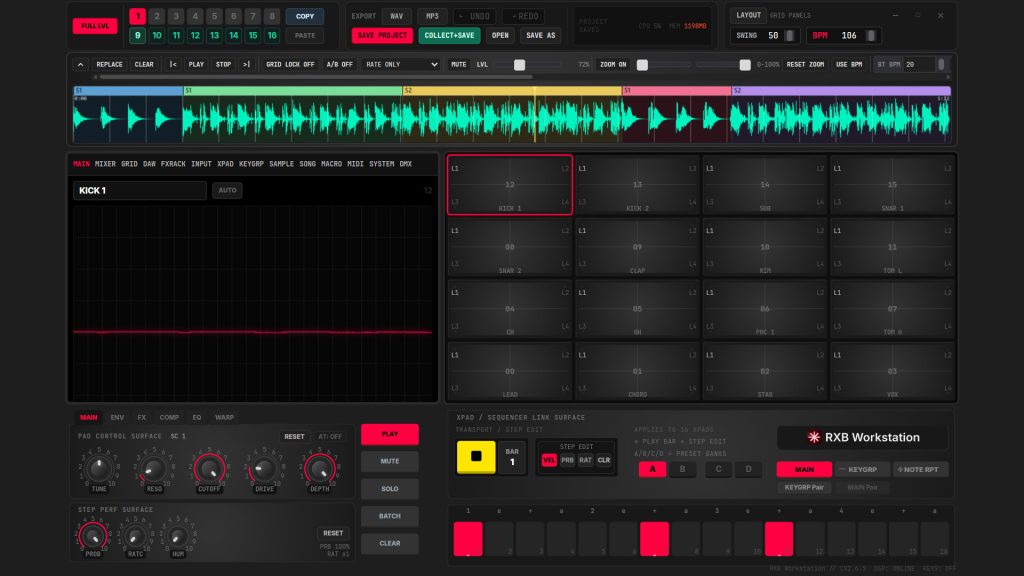
RXB Workstation is a music production and mixing application built around a grid of sixteen sample pads spread across four banks. Each pad holds up to four independent sample layers and every pad is playable as soon as the application opens, with no arming or routing steps required. Patterns are programmed on a 32-step grid with per-step control of velocity, pan, probability and ratchet, and up to sixteen scenes can be stored for arrangement. A keygroup mode converts any bank into a chromatic instrument mapped to a chosen root note and scale, and edits can be made while the transport is running. The application has now moved from development to a released state.
The mixer section provides five summing buses (drums, music, vox, FX and backing), each with level, pan, mute, solo and routing, and pads can be assigned to a bus individually. Metering includes LUFS (momentary, short-term and integrated), true peak, a spectrum analyser and master gain-reduction display. Each pad and the keygroup bus have a three-band parametric EQ, and sidechain compression can be applied with a selectable source pad plus depth, attack and release controls. Eight backing-track lanes offer a multi-lane DAW view sharing one timeline with the song sections, with per-lane volume, pan, mute, solo and clip trimming. Supported import formats are WAV, AIFF, MP3, M4A, FLAC, OGG and WMA, up to 256 MB per file. Sample chopping supports manual, automatic or equal-division slice markers, direct commit of chops to pads, and time-stretching with either a pitch-preserving or repitch mode; all operations are non-destructive to the source file.
Song mode arranges scenes into sections with bar counts and half-bar granularity, with per-section bank and tempo overrides, and a clip launcher triggers scenes live quantised to the bar. Finished arrangements can be exported as a real-time bounce to WAV or MP3. The application also outputs Art-Net DMX over a local network, with a master dimmer, beat sync and eight lighting scenes driven from the same transport as the audio. It runs entirely offline with no account, subscription or internet connection needed. Projects are stored as folders on disk, a Collect + Save function bundles all sample dependencies into a portable project, and the last three versions are kept as automatic backups on each save. The included factory sound library was synthesised by the developer’s own audio engine and its licence permits commercial use of the resulting work. It requires 64-bit Windows 10 or 11, a minimum of 4 GB of RAM (8 GB recommended, 16 GB for larger sessions) and any Windows-compatible audio output, with a dedicated interface reducing latency. The developer notes that latency and voice count depend on the user’s hardware and audio setup, and recommends a 100% Windows display scale.
Steam data
Synced 4 days agoReviews
No user reviews