Crosstalk
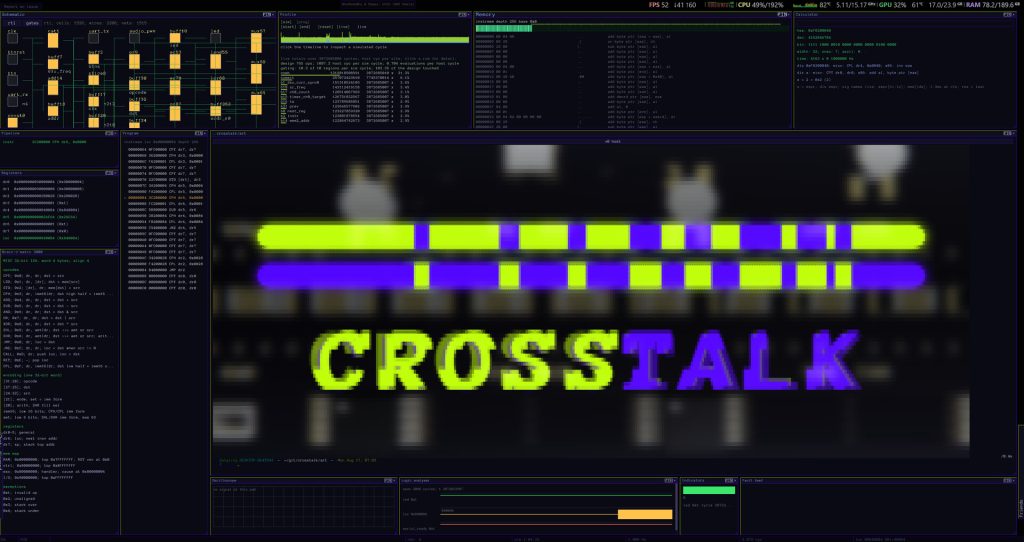
Crosstalk is a sandbox for designing and building electronics and computers from a low level. Players describe hardware in SystemVerilog, simulate or emulate it, and then write software for the result, with example projects ranging from calculators and LED controllers to full computers. The included toolchain has a gate-level SystemVerilog simulator, an elaborator, a synthesiser and a C emitter, along with a bundled Clang compiler that compiles C generated from the player’s own designs so they run faster. A typical session involves arranging a workspace of movable, resizable floating windows, opening a shell to the host machine, writing a design in an editor and then simulating it. The game can be played alone in Self-play mode or cooperatively in a Networked mode using Steam Networking, and designs, software and emulators can be shared through the Steam Workshop.
Several simulation methods are available. Designs can be RTL-simulated, converted to C99 for accelerated execution, or run in an emulation mode that reproduces their behaviour without guaranteeing accuracy. A gate-level simulator runs a synthesised version of a design for higher resolution, although it is slower and limited to smaller designs. Debugging tools include a memory view, an oscilloscope, a register state overview, a stack view that shows a trace on faults, program-level and design-level profilers, and a schematic viewer that displays both RTL and gate-level schematics and highlights heavily used cells. Designs can communicate through virtual in-game serial ports, the host computer’s physical serial ports on Unix and Windows, or the game’s own shell interface, which allows external hardware such as microcontrollers, sensors, buttons or other computers to be connected and represented by stand-in parts. A true-colour terminal emulator compatible with ANSI, VT100, xterm and kitty can act as a serial terminal and connect to the host through PTY or ConPTY. Designs with video output can use interactive CRT, gas-plasma or LCD displays driven through CGA or VGA interfaces.
Players can define their own instruction set architectures, with an in-game help banner available during development. The game also includes its own minimal architecture, known as DANGCSA or DANGXA, and a reference CPU for it called the DLU, which supports serial communication, text mode, video, audio and MIDI. This can serve as a SystemVerilog example or as a ready-made target for players who do not wish to build their own. The bundled LLVM can compile for this architecture and recognises its native binary format, with ELF supported as a compatibility layer. The developer has announced a future DLC focused on guided ISA design and a free DLC game called Hardware Sniffers, written natively for the included architecture. Two DLC items have recently been added to the game’s Steam page.
Steam data
Synced 3 days agoReviews
No user reviews
DLC
17
add-ons available
Latest from the developer
- Crosstalk's license changes to the DELv1
- Crosstalk will go open-source and partially free on Steam
- Crosstalk may be ported to the DANGCSA/DANGXA emulator
- Hardware Sniffers: DANGCSA/DANGXA: Numerics
- Hardware Sniffers: MISC: r0.5.0 revamp
- Brain maps
- Hardware Sniffers: MISC and virtual memory
- Hardware Sniffers: MISC's programming language, DANGC
- Hardware Sniffers: The EMIRU binary format
- All achievements will be removed due to a Valve leak
Announcements posted by the developer on Steam.